

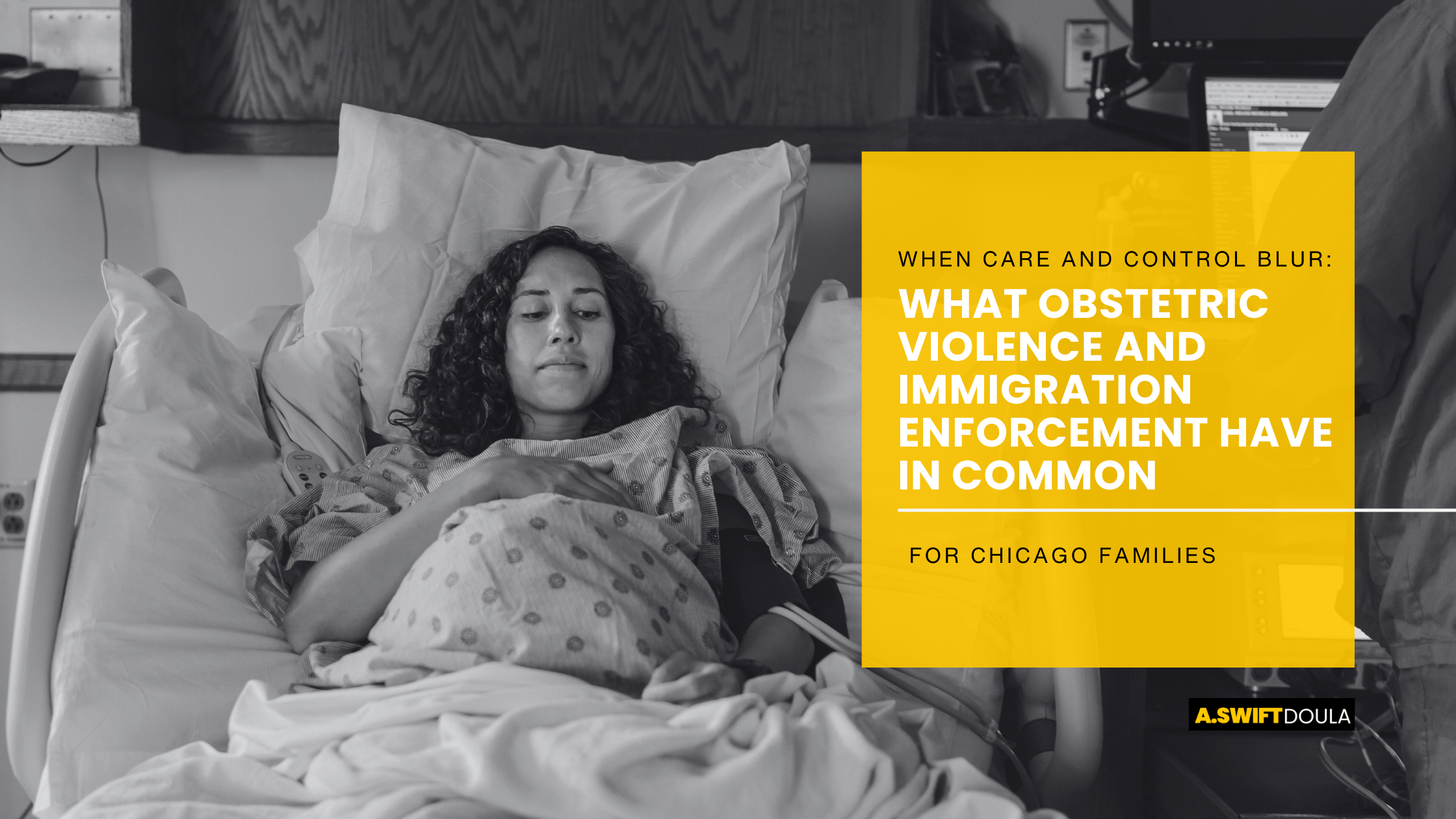
When Care and Control Blur: What Obstetric Violence and Immigration Enforcement Have in Common
Power, Not Just Behavior
It’s easy to ascribe harm to bad actors. Easy to frame violence as the result of individual cruelty, incompetence, or rare moments that are later described as “out of context” or “blown out of proportion.” But the ongoing crisis in maternal health care tells a different story. When harm is patterned, predictable, and disproportionately experienced by the same groups, the issue is no longer behavior. It’s power.
In healthcare, scholars describe obstetric violence as systemic mistreatment rooted in clinical hierarchies, institutional norms, and unequal power dynamics (Bohren et al., 2015; WHO, 2014). This framing matters because it shifts responsibility away from individual intentions and toward the structures that enable harm to occur repeatedly, often without consequence. Harm does not require hostility, only authority exercised without accountability.
Watching news coverage over the past weeks of federal ICE agents moving through communities, many have named what feels increasingly apparent: these actions are not aberrations, but expressions of longstanding authoritarian systems. Our country was built atop these power structures. What feels newly visible is not their existence, but their intensity and brazenness. And it is worth asking where else these dynamics live. Especially in systems that claim to exist for care and protection.
Doulas have been naming what they witness in labor and delivery rooms for decades: coercion disguised as urgency, consent treated as a formality, and patient voices dismissed when they complicate institutional flow. Yet it has been remarkably easy to discredit these observations. Doulas are framed as “non-clinical,” “too emotionally involved,” or incapable of understanding the nuance of complex medical decision-making. This dismissal itself is an exercise of power. The dismissal protects hierarchy by undermining those who challenge it.
The uncomfortable reality is this: a system that cannot follow its own standards of informed consent, and then blames patients when harm occurs, is abusive. Naming that abuse as obstetric violence has provided language, research frameworks, and collective memory—tools that allow us not only to document harm, but to see how it becomes normalized, justified, and passed down as generational trauma.
The actions unfolding under Operation Metro Surge are grotesque in their own right. Videos and firsthand accounts describing human rights violations are brutal to witness, AND they also function as a mirror. They force us to confront why abuses of power, when framed as necessary or protective, are so often tolerated across systems of care, governance, and public service.
There is a clear throughline: authority exercised without meaningful consent.
When you watch what is happening in communities, ask yourself, who gets to decide what is “necessary,” and who absorbs the consequences? Now consider the stories you may already know: women told they need cesareans without explanation, required to receive pitocin, or denied the ability to move their bodies during labor—the setting changes. The logic does not.
***If you are looking for ways to meaningfully engage inside birth rooms as a healthcare worker, or as a birthing person, the bottom of the blog has ideas for how you can participate in disrupting a disfunctional power dynamic.
Authority Over Autonomy
In obstetric care, authority most often presents as medical expertise. Decisions are framed as medically necessary, time-sensitive, or non-negotiable—even when informed consent is partial, rushed, or absent altogether. Research consistently shows that birthing people, especially Black, Indigenous, and other marginalized communities, are disproportionately subjected to unnecessary procedures, dismissive language, and exclusion from meaningful decision-making.
This erosion of agency often begins long before labor. It can surface during prenatal visits when providers introduce induction timelines without a current medical indication, or when questions are met with vague reassurances rather than transparent information. Over time, patients learn which questions are welcome—and which are seen as disruptive. Authority quietly replaces collaboration.
A similar dynamic is visible in Minneapolis, where federal authority has overridden local governance and community autonomy through Operation Metro Surge. Thousands of ICE, Customs and Border Protection, and Homeland Security agents have been deployed into the Twin Cities, described by officials as the “largest immigration operation ever” in the region, involving upwards of 3,000 officers (FOX 9 Minneapolis–St. Paul). Residents did not consent to this presence. Local leadership did not request it. And yet, the operation proceeds under the banner of federal necessity.
The logic is strikingly familiar: urgency, expertise, and institutional backing add up to diminished autonomy.
When authority goes unquestioned, whose body becomes negotiable?
When Coercion Becomes Routine
One of the most insidious features of authoritarian harm is its normalization. What begins as extraordinary becomes routine. What once required explanation becomes unquestioned.
In hospitals, patients are often told, “That’s just how births work.” In Minneapolis, residents now encounter armed federal agents on city sidewalks, conducting stops and arrests in ways that have profoundly unsettled communities (CBS News). The presence of public support from federal officials and the President’s Press Secretary further muddies the waters, even when video evidence shows clear harm.
Sociologists have long noted that institutional violence often hides behind procedure—practices repeated so frequently they fade into the background. Normalization does not mean harmless. It means institutionalized.
“Standard procedure” is a phrase that carries immense power. In medical settings, it often obscures the decision-making process entirely: what alternatives were considered, whose risk was prioritized, and whether the patient had any real opportunity to refuse. Procedure becomes a shield against scrutiny.
Having worked inside birth centers for the past five years, I am not opposed to protocols. Clear guidelines—especially around risk escalation—can be life-saving. They also provide shared language when subjective opinions differ. But guidelines are meant to support care, not override consent.
I doubt many hospital employees believe they are part of a system that depends on patients “not making too much fuss” when their preferences conflict with ward norms. And yet, compliance is often quietly rewarded, while resistance is labeled difficult, unsafe, or irresponsible.
Dehumanization Without A Clear Villain
These harms do not require villains.
In healthcare, patients become “cases,” “risks,” or “noncompliant.” In Minneapolis, residents describe an atmosphere of surveillance and fear, where immigration agents feel omnipresent, reshaping daily life in once-familiar spaces. And some may argue that the use of ICE agents using full face masks to hide their identity would show they know being “anonymous” is an asset to be used against those protesting their use of force.
Technical language—clinical or legal—creates distance from human impact. Emotional detachment becomes a professional survival strategy.
When speed, efficiency, and compliance take priority, humanity becomes inconvenient.
In response to birth data that shows obstetric violence is still a problem, many healthcare institutions and private organizations have begun offering training in client-centered or patient-centered care. These frameworks intentionally place the individual at the center rather than the bottom of the hierarchy. These models challenge systems that distance policy-makers from lived experience and remind providers that dignity is not a soft value; it is a safety requirement.
What gets lost when systems optimize for control instead of care?
Structural Violence: Why These Harms Repeat
Anthropologist Johan Galtung defined structural violence as harm embedded within social systems—violence that disadvantages certain groups without requiring overt malice. Obstetric violence persists because of entrenched hierarchies, liability fears, and training norms that prioritize intervention over autonomy. Immigration enforcement persists because federal authority and political incentives shield operations from accountability (FOX 9 Minneapolis–St. Paul).
Responsibility becomes diffuse. Harm becomes “the system.”
But when harm is predictable, how do individuals remain capable of advocating for their rights?
Why This Comparison Matters
These experiences are not identical. Birth and immigration enforcement operate in distinct legal contexts and carry different stakes. But they share structural similarities in how power is exercised, justified, and protected. Recognizing these patterns helps us stop treating harm as isolated, personal, or inevitable.
Patterns allow movements to learn from one another. They challenge the idea that authoritarian behavior is acceptable simply because it is framed as being “for our own good.”
What Support for Change Can Look Like From the Inside
For healthcare workers, even when leadership isn’t aligned
Healthcare workers are often caught between institutional mandates and ethical care. While systemic reform is essential, harm reduction can and does happen at the bedside:
Practice micro-consent relentlessly. Narrate actions and ask permission.
Translate institutional power. Clarify what is flexible versus mandatory.
Document harm clearly. Chart refusals and distress without judgment.
Slow things down when safe. Time redistributes power.
Build lateral solidarity. Cultural shifts often move peer-to-peer.
Name behavior, not intent. Center impact over assumptions.
Amplify patient voice. Encourage advocates and audible preferences.
Use a human-rights frame. Autonomy and dignity are not optional.
You may not control the system, but you control how power moves through you.
What Advocacy Can Look Like at the Bedside
For families navigating a hospital birth
The responsibility for safe, respectful care should never rest solely on individuals, especially in moments of vulnerability. Still, some tools can help:
Bring a dedicated support person or advocate.
Ask for clear explanations: “Why now?” “What happens if we wait?”
Use explicit consent language: “I do not consent.”
Ask who is making the decision—policy or provider.
Repeat preferences consistently and calmly.
Request pauses or another provider when possible.
Document interactions if needed.
Trust discomfort as information, not failure.
Even the most prepared advocacy does not guarantee freedom from harm. Accountability always lies with institutions and providers, not patients.
Learning to Notice Power
The delivery room and the street may seem worlds apart, but the logic that governs them can feel disturbingly similar. What we can learn from the communities who are disrupting ICE agents agenda is that there is still incredible power to stand as a unified group, with a shared purpose, with a goal to protect humanity and uphold the rules that we require all to abide by, including those in authority.
Where else have we accepted the loss of autonomy because an institution told us it was for our own good?
References
American Psychological Association (APA). (2018). Mental health effects of immigration enforcement.
Bohren, M. A., et al. (2015). The mistreatment of women during childbirth in health facilities globally, PLOS Medicine.
Farmer, P. (2004). An anthropology of structural violence, Current Anthropology.
Galtung, J. (1969). Violence, peace, and peace research, Journal of Peace Research.
Vedam, S., et al. (2019). Mapping integration of respectful maternity care, Birth.
WHO (2014). Disrespect and abuse during facility-based childbirth.
Federal agents have been widely deployed in Minneapolis enforcement operations, including reported shootings and protests. (CBS News)
Minnesota is challenging the federal surge in court amid intense local backlash. (Minnesota Reformer)
Reports confirm multiple deaths involving federal agents and local demands for withdrawal. (AP News)
The scale of federal deployment has been described as “largest immigration operation ever” in the Twin Cities. (FOX 9 Minneapolis-St. Paul)